 NexScrm官方博客
Many people think an AI customer service assistant is for "24/7 auto-replies," but the core of selection is first calculating the cost per reply, then deciding which conversations to hand to AI and which must go to human agents.
Starting August 1, 2026, Meta will charge per token for AI-generated replies sent by Meta Business Agent on the WhatsApp Business Platform (standard rate $2.00 per million tokens, with a typical interactive reply costing about 4-5 cents). From October 1, the policy of free Service messages within the 24-hour customer service window (non-template manual replies and third-party AI solution replies) will be canceled, shifting fully to fixed per-message fees by region. This means the era of cross-border teams relying on the free customer service window for "zero-cost typing" is over, and the value of AI customer service assistants must be recalculated from the cost ledger.
Turn Selection into a Formula: What Does One AI Customer Service Reply Actually Cost?
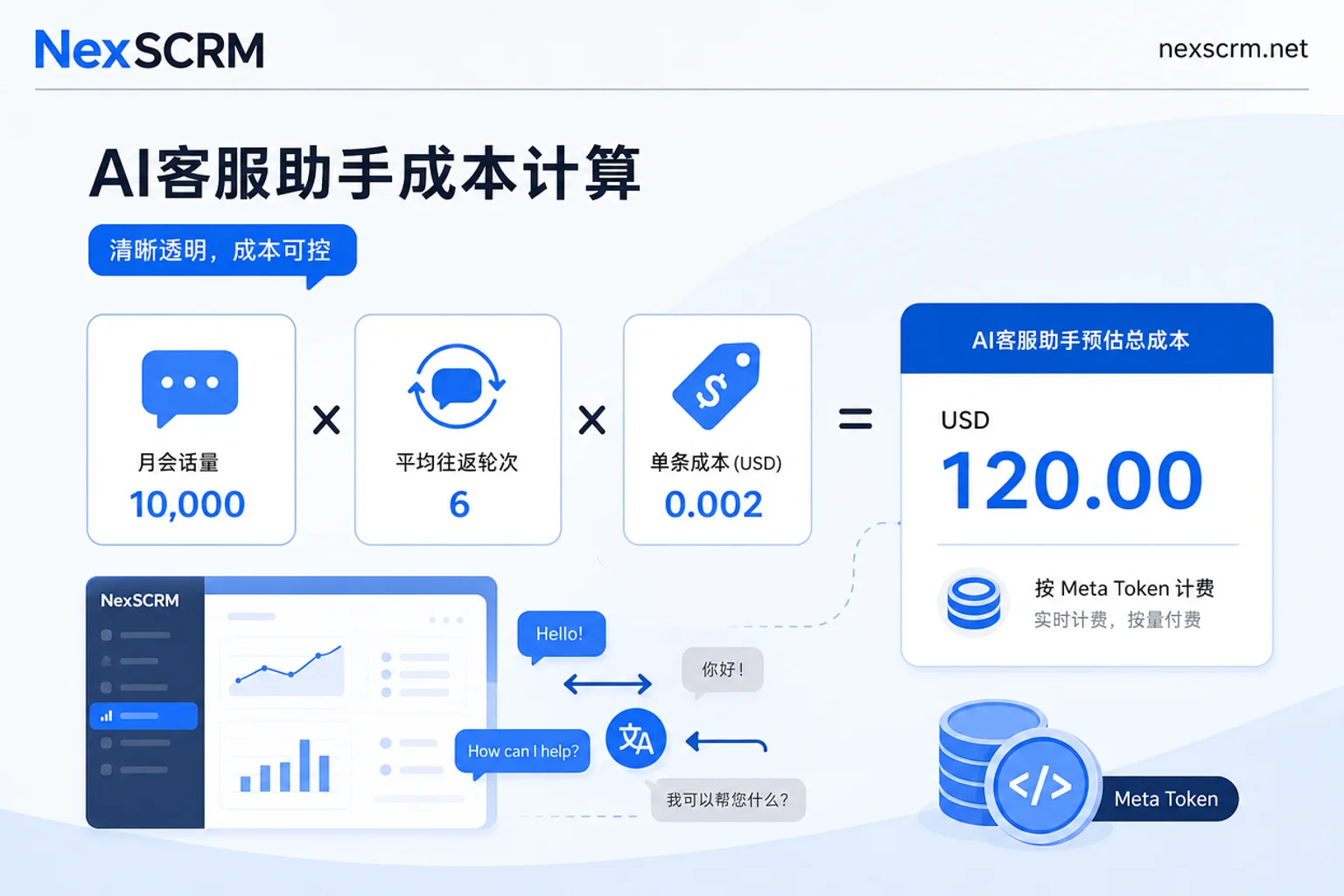
Instead of agonizing over vendor feature lists, calculate it yourself first. Monthly cost = monthly conversations × average round trips × cost per message (AI replies billed per token, human replies per-message fee, calculated separately). For example: assume 3,000 monthly conversations, an average of 3 AI rounds per conversation, and a cost of $0.05 per AI reply, the AI portion costs $450; if 20% of conversations are transferred to human agents, with 6 human round trips per conversation and a regional per-message rate of $0.06, the human cost is approximately $216. The "assumptions" here are just sample variables; be sure to replace them with your own dashboard's conversation volume, round trips, and regional rates—Meta's official pricing page (developers.facebook.com/docs/whatsapp/pricing) provides specific numbers for each region.
Criterion 1: Trigger Boundaries—Which Conversations Get AI First, Which Must Go Directly to Human
How should AI customer service assistants and human agents divide work? The answer is to categorize conversations. Put repetitive high-frequency issues like logistics tracking, common spec Q&A, and after-sales progress into a whitelist for AI auto-replies; high-risk or high-value conversations like quotes and negotiations, custom requirements, and complaints must be directly connected to human agents. For the division of conversation types, you can refer to the conversation routing logic of cross-border customer service software. Trigger conditions must be configurable and disableable; otherwise, with per-message billing, unbounded auto-replies amplify both costs and risks—every extra AI turn means another token or message fee. Whether this boundary is worth configuring depends on the proportion of repetitive issues in your conversation structure.
Criterion 2: Transfer-to-Human Thresholds—How to Set Signals for Recognition Failure, Negotiation, and Complaints
When should AI customer service assistants transfer to human? Don't wait until the conversation spirals out of control. Set three types of trigger signals: if confidence in intent recognition is insufficient for two consecutive rounds, transfer immediately; if sensitive words like price, payment terms, or discounts appear, escalate; if negative sentiment or complaint keywords arise, intervene right away. Thresholds should be combined with response time limits and agent scheduling to prevent AI from going in circles—both dragging out conversations and adding message fees. If response quality is unstable, besides setting thresholds, you can also enable a workflow in the backend where AI drafts and human confirms before sending. For example, NexSCRM's AI-assisted reply supports this workflow: AI generates a draft, the agent confirms before sending, retaining AI's speed while leaving final wording control to humans. Additionally, real-time two-way translation helps agents in different languages understand customer messages on the same interface, reducing invalid round trips caused by comprehension gaps.
Criterion 3: Multilingual Accuracy—How to Sample Test Before Launch for Less Common Languages
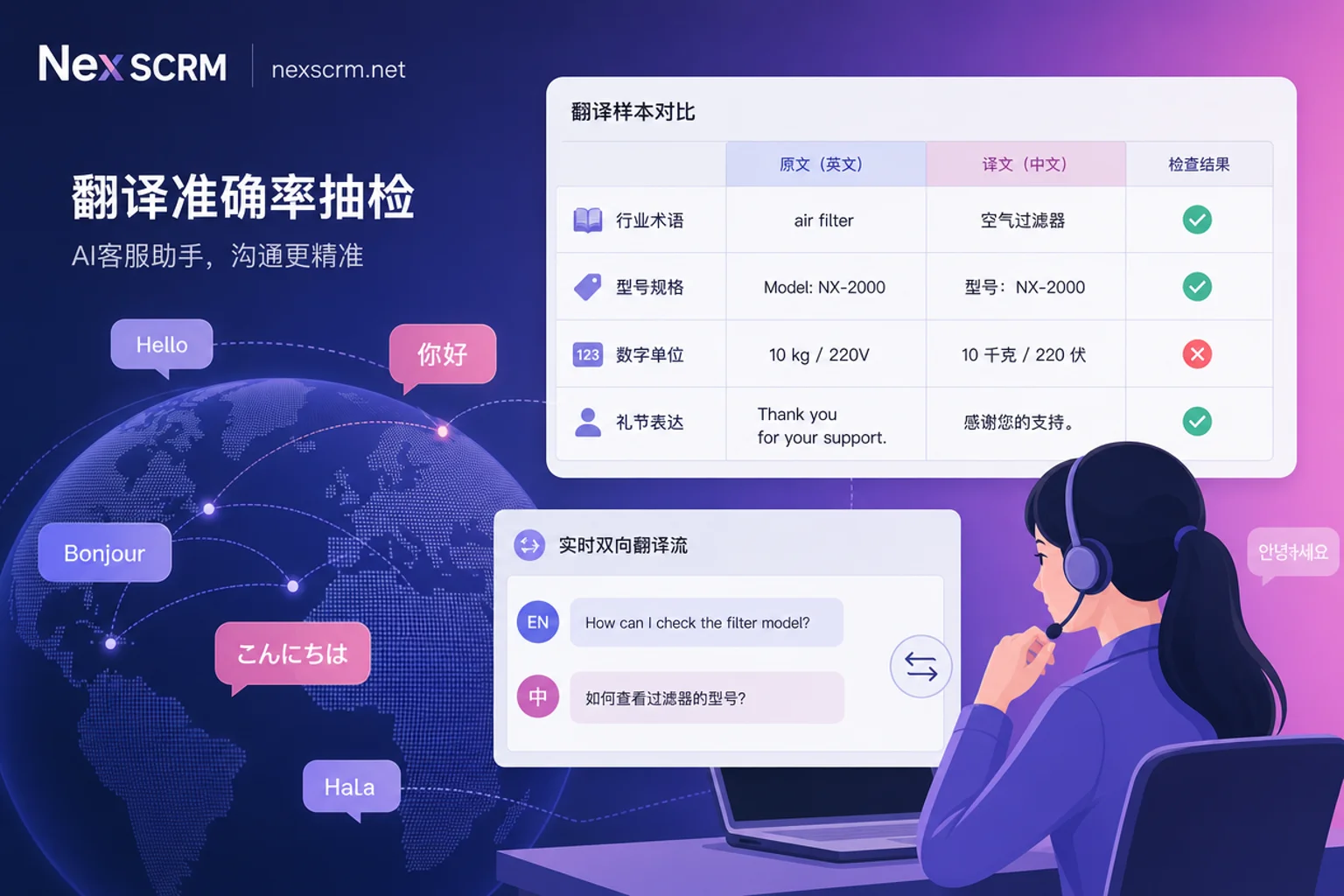
The translation accuracy of multilingual AI customer service assistants isn't based on vendor claims but on your own sampling (sample size and thresholds are implementation suggestions, not official standards; adjust according to your conversation structure). The method is simple: extract at least 50 messages per language from historical real conversations, covering four categories: industry terms, model specifications, numbers and units, and polite expressions; have two colleagues proficient in that language independently score, recording error types (omissions, mistranslations, inappropriate tone, etc.) rather than just overall "accuracy." If terminology error rates in your test set are notably high (suggest setting your own warning line at 10%), it indicates a need to supplement the terminology database or limit the auto-reply scope for that language.
Criterion 4: Measurability—Can You Pull Reports on Message Counts, Costs, and AI Involvement Rate?
Under per-message/per-token billing, bill verification is a hard requirement. The tool must be able to output message counts, AI involvement rate, transfer-to-human rate, and cost allocation by account, by agent, and by language. Otherwise, when the month-end bill arrives, you can't even say which messages you owe for. For instance, NexSCRM provides message and marketing data analytics, as well as multi-platform, multi-account aggregated conversation capabilities, making every message and cost traceable and verifiable—this is a key capability to examine when selecting a WhatsApp SCRM. Additionally, cost statistics should ideally align with WhatsApp customer service performance metrics for foreign trade teams, making agents aware that every reply incurs cost, not "typing is free."
Configuration Examples and Monthly Cost Comparison for Three Team Sizes
The table below is calculated with monthly conversation volumes of 1,200, 3,600, and 6,000, an average of 3 AI rounds per conversation, and 6 human round trips.
| Team Size | AI Handling Ratio | Transfer-to-Human Threshold | Sampling Frequency | Monthly Cost Example (sample variables; replace with your own conversation volume and regional rates) |
|---|---|---|---|---|
| 1-3 person small team | 40% | Loose (only logistics queries) | Once a month | AI approx. $180, human approx. $100 |
| 5-15 person support group | 60% | Medium (sensitive words + confidence) | Every two weeks | AI approx. $540, human approx. $300 |
| Multi-country multilingual team | 70% | Strict (all three signals) | Once a week | AI approx. $900, human approx. $500 |
The above costs are based on sample variables of $0.05 per AI reply and $0.06 per human message rate; replace with Meta's official pricing page (developers.facebook.com/docs/whatsapp/pricing) and your own conversation data. For selecting a multilingual customer service system, we recommend adjusting the AI handling ratio based on multilingual sampling results.
Pre-Launch Self-Checklist: Don't Use AI Customer Service as a Broadcast Tool
Deploying an AI customer service assistant isn't just setting up auto-replies. Check off each item before launch:
- Trigger boundaries reviewed: Are whitelist/blacklist conversation types clear? Can auto-replies be disabled at any time?
- Transfer rehearsed: Do the three signals trigger correctly? Can agents take over within 30 seconds after transfer?
- Terminology database and scripts reviewed: Do they cover high-frequency industry terms, models, numbers, and units, avoiding "translationese"?
- Billing reconciliation frequency set: Pull a cost report weekly to check for abnormal token usage.
- Compliance and account security: Are you following WhatsApp policies to avoid account bans due to misuse?
- Workflow confirmed: Is the AI-draft, human-confirm-and-send process assigned to every agent?
The ultimate goal of cost control is reducing invalid round trips, not bypassing platform billing. Using it as a broadcast tool wastes money and risks penalties.
FAQ
Is AI customer service worth it for cross-border e-commerce?
Yes, but only if you first calculate costs. If monthly conversation volume is low (e.g., under 1,000), the labor savings from AI may not outweigh per-message costs; if volume is high and repetitive issues are common, AI can significantly reduce labor costs. We recommend running last month's data through the formula above before deciding.
How much does WhatsApp AI auto-reply cost?
From August 2026, it's billed per token: about $2 per million tokens, with a typical AI reply costing around 4-5 cents. Human replies will be charged per message by region starting October 1. The exact amount depends on the number of round trips and the service message rate in the recipient's region, so verify with your own bill.
What should I do if the AI customer service replies are inaccurate?
First, adjust trigger boundaries to transfer conversation types the AI handles poorly to human agents. Second, supplement the terminology database and scripts to improve accuracy on professional terms. Finally, set transfer thresholds: if confidence is low for two consecutive rounds, automatically transfer to human to avoid customers getting frustrated by wrong replies.
How do I measure the translation accuracy of a multilingual AI customer service assistant?
Sample at least 50 messages per language from historical conversations (suggested value), covering terminology, specifications, numbers, and etiquette. Have two colleagues proficient in that language independently score, focusing on error types rather than overall accuracy. If terminology error rates are notably high (suggest setting your own warning line at 10%), it's time to expand the terminology database or restrict auto-replies for that language.
When should AI customer service transfer to human?
Transfer when any of these three signals occurs: intent recognition confidence is insufficient for two consecutive rounds, price/payment terms/discount words appear, or negative sentiment/complaint words appear. Transfer to human immediately, while also keeping response time limits in mind to avoid long waits for customers.


Comments(0)